Rise Recliners and Pressure Care: An Australian Guide to Comfort, Skin Health and Pressure Injury Prevention
20 May 2026
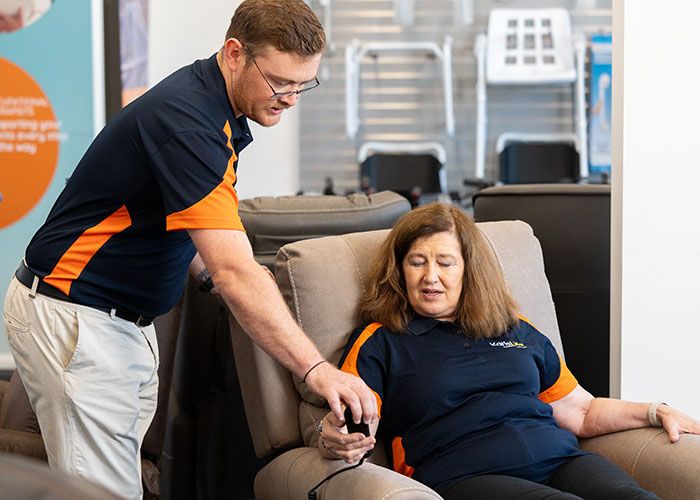
For Australians who spend long hours sitting — older adults, NDIS participants, post-surgery patients and people living with chronic illness — pressure care is one of the most important conversations to have with an occupational therapist. Prolonged sitting without proper support can cause skin breakdown, discomfort and serious pressure injuries (also known as pressure sores or pressure ulcers). The right rise recliner, paired with a clinically chosen cushion, is one of the most effective ways to reduce that risk while still allowing the user to relax, read, sleep or watch TV in comfort. This guide explains how rise recliners support pressure care, what features to look for, and how to access funding through the NDIS and Support at Home programs.
What Is Pressure Care and Why Does It Matter?
Pressure care is the clinical practice of preventing and managing pressure injuries — localised damage to the skin and underlying tissue caused by sustained pressure, friction or shear. According to Australian Commission on Safety and Quality in Health Care data, pressure injuries are one of the most common preventable harms in aged-care and community settings, and they affect tens of thousands of older Australians each year.
Pressure injuries can develop in as little as two hours of unrelieved pressure on a bony prominence such as the sacrum, heels, hips or elbows. The national pressure-injury prevention standard encourages early identification, repositioning, skin checks, nutrition and the use of pressure-redistributing equipment — including specialist seating such as rise recliner chairs and pressure-care cushions.
Who Is Most at Risk of Pressure Sores?
Anyone who sits or lies in the same position for extended periods is at risk, but the highest-risk groups in Australia include:
- Older adults with reduced mobility, frailty or cognitive impairment
- NDIS participants with spinal cord injury, MS, cerebral palsy, MND or post-stroke paralysis
- People recovering from major surgery (hip, knee, cardiac, abdominal)
- Bariatric users where extra body weight increases tissue load
- Diabetic and vascular patients with reduced circulation and sensation
- Palliative-care patients spend most of the day in one chair or bed
For all of these users, a standard armchair simply does not redistribute pressure. A correctly specified rise recliner does — by changing position, supporting weight evenly and pairing with a clinical cushion.
How Rise Recliners Support Pressure Care
A rise recliner contributes to pressure care in three clinically important ways: postural change, weight redistribution and circulation support.
1. Postural Change (the most underrated feature)
Pressure injuries develop when the same tissues bear load for too long. Best-practice guidance recommends repositioning every 2–4 hours. A rise recliner makes this effortless — a single button on the handset moves the user from upright sitting to reclined, then to leg-elevated, then back. Even small changes in angle move the contact point away from the sacrum and ischial tuberosities, where most chair-related pressure sores form.
2. Weight Redistribution
Quality rise recliners are built around a high-density foam seat base and a pressure-redistributing cushion. The foam spreads the user’s weight across the whole seat instead of concentrating it on bony points. Multi-layer cushions add gel, memory foam or air-cell technology for users at very high risk.
3. Circulation and Oedema Management
Dual and multi-motor rise recliners elevate the legs independently of the backrest, raising the feet above heart level to assist venous return and reduce swelling. Improved circulation directly reduces pressure-injury risk because well-perfused tissue tolerates load far better than ischaemic tissue.
Key Pressure-Relieving Features to Look For
When choosing a rise recliner for pressure care, the Karis Life clinical team and visiting OTs typically prioritise the following features:
- High-density foam (HR foam) seat base, ideally 50+ kg/m³ density
- Removable pressure-relieving cushion with gel or memory-foam layer
- Dual or multi-motor operation for independent leg elevation
- Tilt-in-space function (clinical models) for true weight redistribution
- Wide, contoured seat with no sharp edges at the front
- Reinforced bariatric frame for users who weigh more than 130 kg
- Breathable, fluid-resistant, wipe-down upholstery (medical-grade vinyl)
- Battery backup so the chair can be lowered safely during a power outage
- Optional heat and massage functions to stimulate circulation
Bariatric Rise Recliners for Pressure Care
Bariatric users face a higher pressure-injury risk because greater body weight increases tissue load at the same time that mobility is reduced. A standard rise recliner is not built for this — bariatric chairs typically offer:
- Weight capacities from 200 kg up to 320 kg
- Reinforced welded steel frame and heavy-duty actuators
- Wider seat (60–75 cm) with deeper cushioning
- Higher seat-to-floor measurements to assist sit-to-stand
- Wider armrests for safer transfers
- Specialist pressure-care upholstery and removable covers
The Role of Pressure-Care Cushions
A rise recliner is only half the solution. For users at moderate-to-high risk, an occupational therapist will almost always recommend a separate pressure-care cushion to sit on top of the chair cushion. Common categories include:
- Foam pressure-relief cushions — entry level, suitable for low risk
- Gel-and-foam combo cushions — moderate risk, good for warm climates
- Memory foam contoured cushions — moderate-to-high risk, very stable
- Air-cell cushions (e.g., Roho-style) — high to very high risk, post-injury
- Hybrid cushions with multiple layers — versatile, often NDIS-funded
Choosing the right cushion depends on the user’s risk level (often measured with the Braden or Waterlow scale), posture, transfer ability and skin condition. Always trial the cushion in the actual chair before purchase.
Visit the Karis Life AT Assessment Clinic in Hornsby to trial dual-motor rise recliners and pressure cushions side-by-side, or hire a chair for short-term post-surgery use.
Proper Positioning — The Detail That Makes the Difference
Even the best rise recliner will not deliver pressure care if it is not fitted correctly. Common positioning errors include seats that are too long (causing forward slide and sacral shearing), backrests that don’t support the head and neck in recline, and footrests set too high (lifting the heels into a pressure point). The Karis Life clinical team measures every user against six fit checkpoints:
- Seat width — at least 25 mm clearance on each hip
- Seat depth — two finger-widths between the back of the knee and the seat front
- Seat-to-floor height — feet flat on the floor, hips slightly above the knees
- Backrest height — supports the head in full recline
- Armrest height — elbows resting comfortably at 90°
- Recline range — independent leg elevation if dual/multi-motor
NDIS, Support at Home and Funding for Pressure-Care Seating
Rise recliners and pressure-care cushions are recognised Assistive Technology items in Australia. Karis Life is a registered NDIS provider and routinely supplies pressure-care seating through:
- NDIS — under the NDIS Assistive Technology framework. An OT assessment is required, and quotes are obtained from a registered supplier.
- Support at Home — the new Support at Home program (from 1 July 2025) includes an AT and Home Modifications scheme that can fund pressure-care recliners for eligible older Australians.
- My Aged Care — Home Care Package funds can be applied for via My Aged Care.
- DVA — eligible veterans can access pressure-care seating through the Rehabilitation Appliances Program with an OT prescription.
Need help navigating the new funding rules? Read the Karis Life Support at Home and AT funding guide or talk to our case-manager support team.
For Occupational Therapists and Case Managers
Karis Life supplies pressure-care rise recliners across Sydney and regional NSW for prescribing OTs and case managers. The OT support hub has clinical specifications, AT trial bookings, in-home assessments and CPD-aligned education sessions on pressure care, seating and transfers.
Try a Pressure-Care Rise Recliner at Karis Life, Hornsby
A rise recliner for pressure care is a clinical decision, not a furniture purchase. With 40+ years of experience supporting older Australians, NDIS participants and carers, Karis Life (formerly Comfort Discovered) helps you choose the right combination of chair, cushion and accessories. Visit our Hornsby showroom, book an in-home assessment, or contact us on 1300 662 880.
Frequently Asked Questions — Rise Recliners & Pressure Care
Can a rise recliner really prevent pressure sores?
A rise recliner alone will not prevent pressure sores in a high-risk user — but when combined with regular repositioning, a clinically chosen pressure-care cushion and good skin care, it is one of the most effective non-surgical strategies available. Tilt-in-space and dual-motor models provide the strongest pressure redistribution.
What is the difference between pressure care and comfort seating?
Comfort seating prioritises subjective comfort. Pressure care is a clinical practice that prevents skin and tissue damage. A pressure-care rise recliner is built with measured weight redistribution, foam density and motor configuration to reduce injury risk, not just feel soft.
Are pressure-care rise recliners funded by the NDIS?
Yes. Pressure-care rise recliners are classified as low or mid-cost Assistive Technology under the NDIS. An OT assessment and quotes from a registered AT supplier are required. Karis Life is a registered NDIS provider and can supply, deliver and install across Sydney and NSW.
Do I also need a pressure-care cushion if I buy a clinical rise recliner?
Usually yes. The chair provides the structural redistribution, but a dedicated pressure-care cushion adds a second layer of protection tailored to the user’s skin risk score (Braden or Waterlow). OTs almost always prescribe the two together for moderate-to-high risk users.
How often should I reposition in a rise recliner to support pressure care?
Best-practice guidance is to change position every 2–4 hours during waking hours. With a rise recliner, this is as simple as pressing the handset to alternate between upright, reclined and leg-elevated positions, with a full stand-and-walk movement every 4 hours where possible.

Keep abreast of the latest developments
Stay in the know about current offers, specials, discounts, and hot new product reviews by signing up for our newsletter.
Contact Us
Book a trial. Arrange a free consultation. Ask a question. Or learn more. Get in touch.
P: 1300 662 880
73 Jersey Street North
Hornsby NSW 2077
ABN 58 136 640 983
ACN 136 640 983
Opening Hours
Mon-Fri: 9.00am - 5.00pm
Sat: 9.00am - 4.00pm
Sun: By appointment
Public Holidays
We are closed on Monday, 8 June 2026, for the Kings Birthday.
Visiting Us?
Directions to our showroom are here >
© 2026 "Karis Life", "Assistive Independence" & "Comfort Discovered" are registered Trade Marks of Progalore Pty Ltd. ABN 58 136 640 983